SPACE IS AN ILLUSION
SPACE IS AN ILLUSION
A tribute to Nanda Vigo
04→11.2025
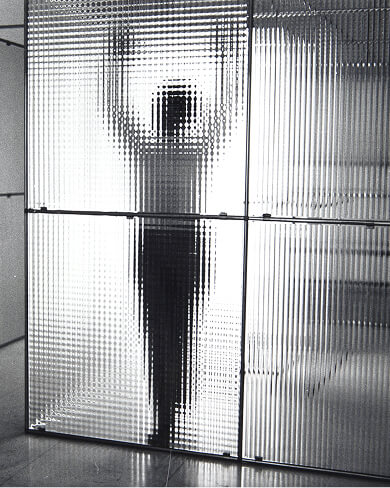
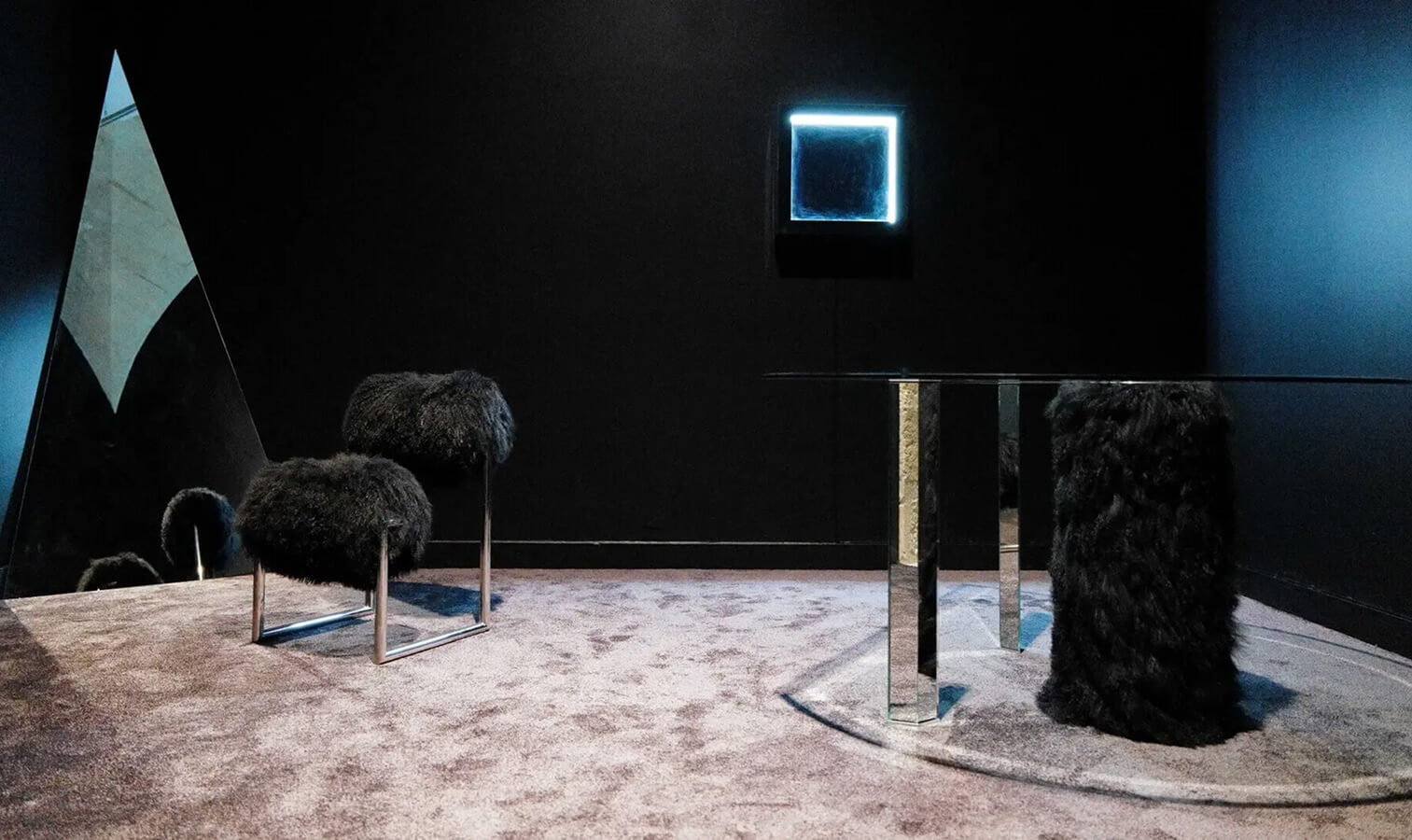
Space is an illusion. With this premise, Moroso pays tribute to the work of Nanda Vigo by integrating some of her works into the Flagship Store in via Pontaccio 8 in Milan. An operation that, in the intentions of Patrizia Moroso, presupposes the understanding of space as a set of events that, in the constant interaction between people, objects, colors, lights, sounds and smells, happen and are daily renewed. A bold impulse to conceive the house as a place where to stage the spectacle of living, in continuity with the thought of Vigo; a house that loses its original destination in favor of an ambiguity perceptive but at the same time protective. House-refuge in balance between intimacy and appearance, between public and private, home able to transform the very life of people into a work of art.
Nanda Vigo: Nonconformist experimenter
Dominique Stella, April 8, 2025
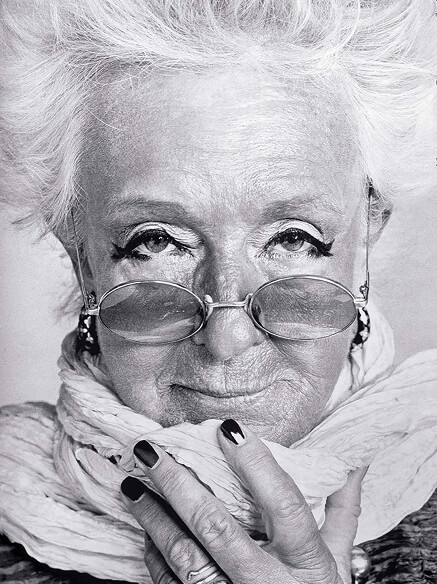
Born in Milan in 1936. She had a studio in Milan, and often lived in East Africa. Nanda Vigo showed an interest in art at a very early age, when she had the opportunity to meet Filippo de Pisi, a family friend, and to study the architecture of Giuseppe Terragni, in which she immediately perceived the subtle use of natural light. She studied architecture at the Polytechnic of Lausanne, worked as an intern in San Francisco, and then returned to Italy where she opened her own studio in Milan. The main feature of her work has always been the relationship between light and space, which Nanda has developed into a series of “environments” in which architecture and design merge.
In 1959 she started to attend the studio of Lucio Fontana and got to know the artists who founded the Azimut Gallery in Milan: Piero Manzoni, Enrico Castellani and Vincenzo Agnetti. During this period, she developed relationships with the artists of the Zero group in Germany, the Netherlands and France, which gave her the opportunity to show her works in more than 400 personal and collective exhibitions throughout Europe.
Remaining faithful to the artistic convictions that she has defended throughout her career, Nanda Vigo, in her work has mixed art, design, architecture and ‘environments’, without making any distinction between these three artistic disciplines, and with the intimate conviction that the concept makes explicit a representative search, beyond art, of a spiritual and almost initiatic way. Her unconventional career has been distinguished by the emphasis placed on research free from disciplinary limits, where inspiration comes from philosophical theories rather than aesthetic doctrines.
Nanda has always privileged experimentation and the exploration of new ways: performances, installations, happenings are part of her artistic language, in parallel to the exercise of architecture that naturally led her towards design.
The space/light concept
In 1960 the Chronotopes were born, opening the way to her research on light as a major element of an artistic reflection that combines art, philosophy and spirituality. Her work reveals the essence of form and light from which she has drawn works able to interact, through their radiation, with the invisible vibrations of space. Her art exalts the idea of a space absorbed in the immateriality of the games of reflections and light, transparency and illusion, capable of disturbing the minds.
Nanda Vigo set a poetic and cosmic dynamic, close to the theories of the German Zero Group that intended to explore the capabilities of materials, then little exploited in the artistic field, stimulating the sensations related to movement and light. Zero suggests placing man in a system of universal references that knows no limit of time or space. For conviction and affinity, Nanda Vigo is therefore linked to the German group of which she adopts the fundamental principles of «Cosmic Power», privileging exploration rather than analysis, inspired by philosophical theories rather than aesthetic doctrines. The interiors, like the objects of art, conceived by you, obey this global theory.
Exhibited items
 Nanda Vigo, Chronotope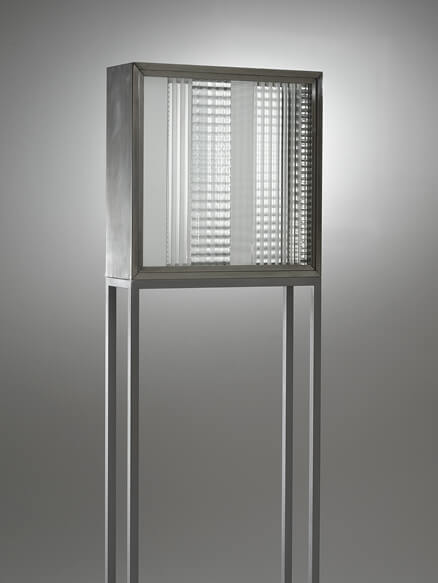
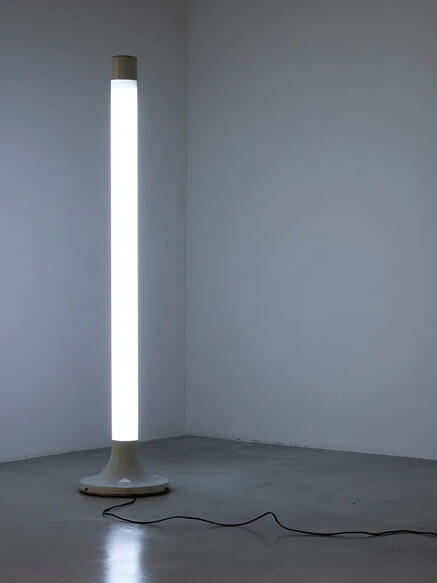
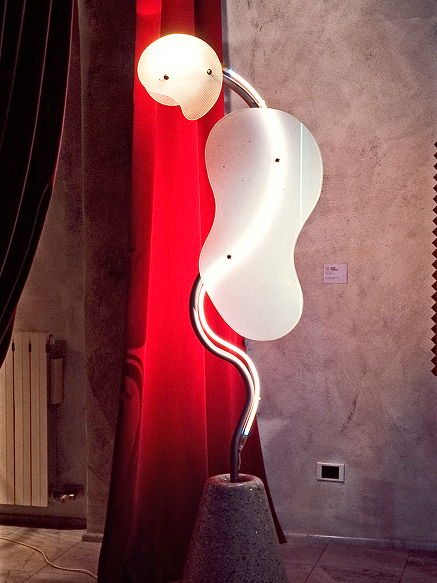
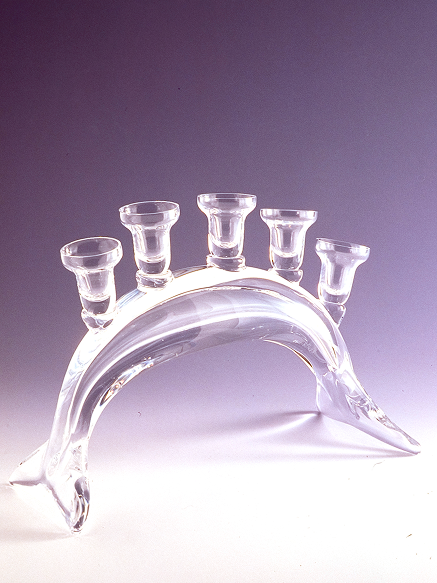
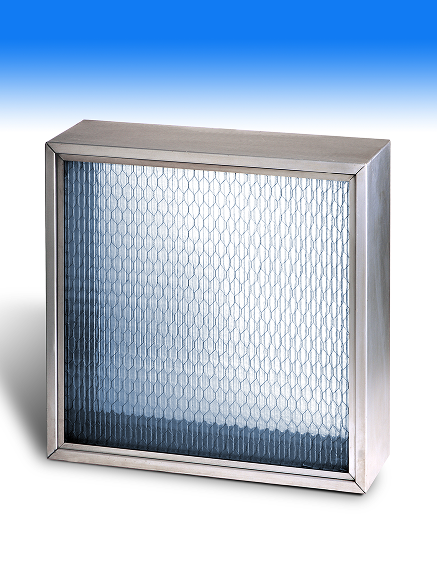
The Chronotope
In 1959 she conceived her first works which she titled Cronotopi (etymologically Space-Time) translating under this name her own philosophical research on the concepts of time and space.
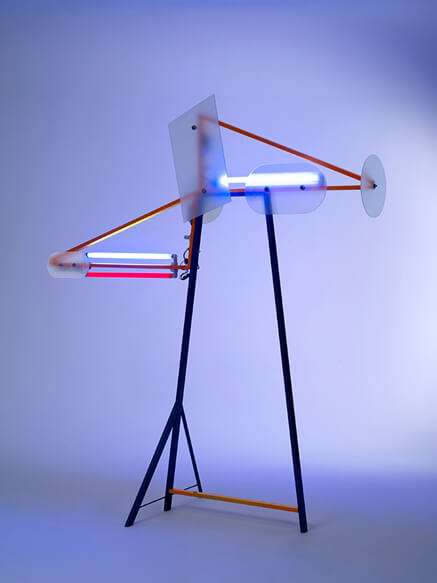
«Cronotopo is outside the centre, towards non-dimension, towards metaphysics which, merging with the reality of the material, acquires an extreme precision in her work»1 wrote Schoonhoven. The abolition of all temporal and spatial dimensions corresponds in Nanda to the desire to access higher degrees of spirit. The chronotope represents the fusion of time (cronos) with space (topos) through light. The Cronotopo stages indirect light, filtered by materials that generate impressions of mutation, uncertain sensations in the perception of space, the variability of the effects of light induces an indefinite reading of the forms.
It is a concept designed to break the physical boundaries of space in order to achieve psychological well-being. The artist achieves this ideal state by optimizing the variability of neon light integrated into a glass and aluminum structure. This union creates a visual disturbance amplified by the reflective surfaces. It is a global concept to which Nanda attributes a spatial, temporal and above all metaphysical value.
1 I. J. Schoonhoven, 1965 from the catalogue of the exhibition at the Delta Kunstring Gallery in Rotterdam, 1965.
Trigger Of Space
The shape of the pyramid is, in the work of Nanda Vigo, a reference, of initial value to the radiation of energy emanated from the pyramid of Cheope: «Light perfect, of the center of Cheopes» writes Nanda. In her text Exoteric Galte (through the cosmic dream) of 1976, the artist highlights a trilogy on three levels between real, unreal and transcendence. Three states at the base of her research, which the reflective surfaces manage to trigger «[…] determine the exact moment in which the unreal becomes real to assume the transcendent aspect of illusion».
Through the series of works Trigger of the Space, started in the 70’s, Nanda Vigo modulates and modifies our space-time, with references taken from the Cosmogonic Alphabet, The first and oldest language of writing from which Nanda extrapolates the geometric shapes of the square and the triangle. They represent respectively the earth and the sky and inspire her in the realization of pyramidal and mirror geometric elements.
The Space Stimulators are luminous sculptures with intense reflections made with mirrors and neon lights. They appear as springboards to new worlds, open doors to vast and unknown universes. They are spaces to be lived and when you penetrate them, you are captured by a multiple vision of continuous and infinite diffractions that compare the viewer to his own image and his own state of “reflection”. The reality of the body and image is questioned: the “stimulator” becomes a place of metamorphosis. To reach its mystifying dimension, the work, which acquires value only in the moment of “lived”, activates the feeling of illusion and dematerialization, the ultimate goal to which the artist aspires.
Light Trees
They are sculptures and determine one of the main axes of the artist’s research in the 90s and mark a transitional period, where technology and poetry complement each other to best convey the expression of vital forces and the aspiration for the tree’s emblematic verticality.
The artist gives a precise description: «The poetics of the project of these Light Trees is a story of sound, musical deviations, gathered in formal schemes that refer to the first evolution of cosmogonic signs, and that is to the symbolism of the tree, considered by ancient writings as producer of life: Roots in the earth, branch towards the sun, a logical figuration especially if the branch brings the light whose propagation in space gives us the mathematical formulation, the only one. Not relative»2. For Nanda the Light Trees, even if they are hung on a wall, have a totemic value. The artist preserves the technological aspect in an evident poetic harmony obtained through the use of a symbology of forms capable of inducing mental suggestions.
Indeed, beyond the message of verticality, the Trees of Light are covered with fragmented screens in the form of primordial elements that refer to the Cosmogonic Alphabet: squares, rectangles, circles of fluted or frosted glass, geometric fragments of mirrors that serve as filters to deconstruct the vertical effect of neon light. In this way the object is freed from the functional dimension to become sculpture.
2 From a text by Nanda Vigo of 13 September 1983, published in Nanda Vigo, Light is Live, Johan & Levi publisher, Milan, 2006, p. 68. 68.
Dynosaurs Box
This box is a time travel room: a miniaturized Trip’s room that refers to the artist’s distant past and most personal memories. Nanda, in this box, captured a parcel of prehistoric life and trapped it in a maze of glass and mirrors, which reflect the blue bodies of dinosaurs, witnesses of remote times but still alive in her mind. The installation emphasizes the value of the past, a basic component of the artist’s experiment.
Nanda Vigo travels with an obsessive will the way that would allow you to glimpse a universal wisdom, through a journey that develops the ephemeral points of precious memories enclosed in minimal objects related to intimate moments of life. The dinosaurs, phantasmagorical animals drawn from archaic mythologies – which Nanda calls «Karmatiche» – are part of the intimate and universal memory and refer to the artist’s childhood, when as a child she immersed herself in reading the albums of Flash Gordon. The worlds of science fiction have shaped the soul of the child who, as an adult, projected the wonders and fears lived through this singular mythology, in dreams from which she was able to build a life of art.
Exhibited posters
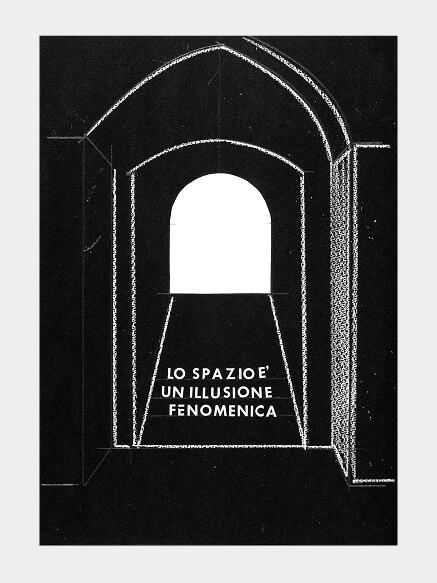 Nanda Vigo Passato e Presente
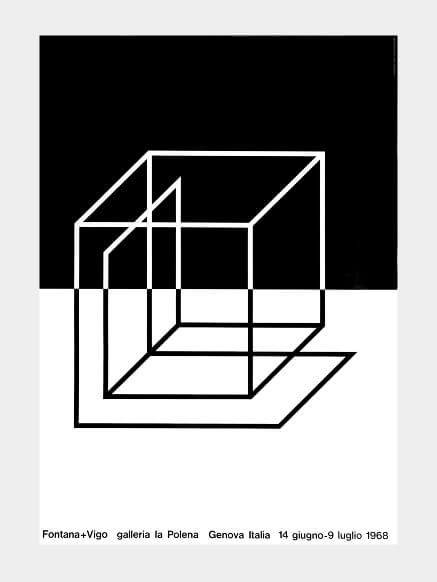 Nanda Vigo Passato e Presente
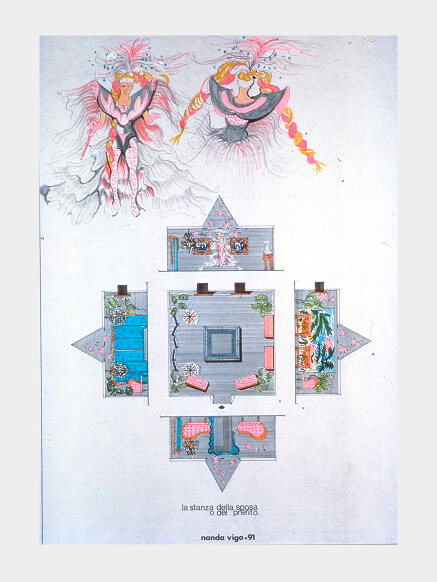 TBD
TBD